
 By Navjivan Express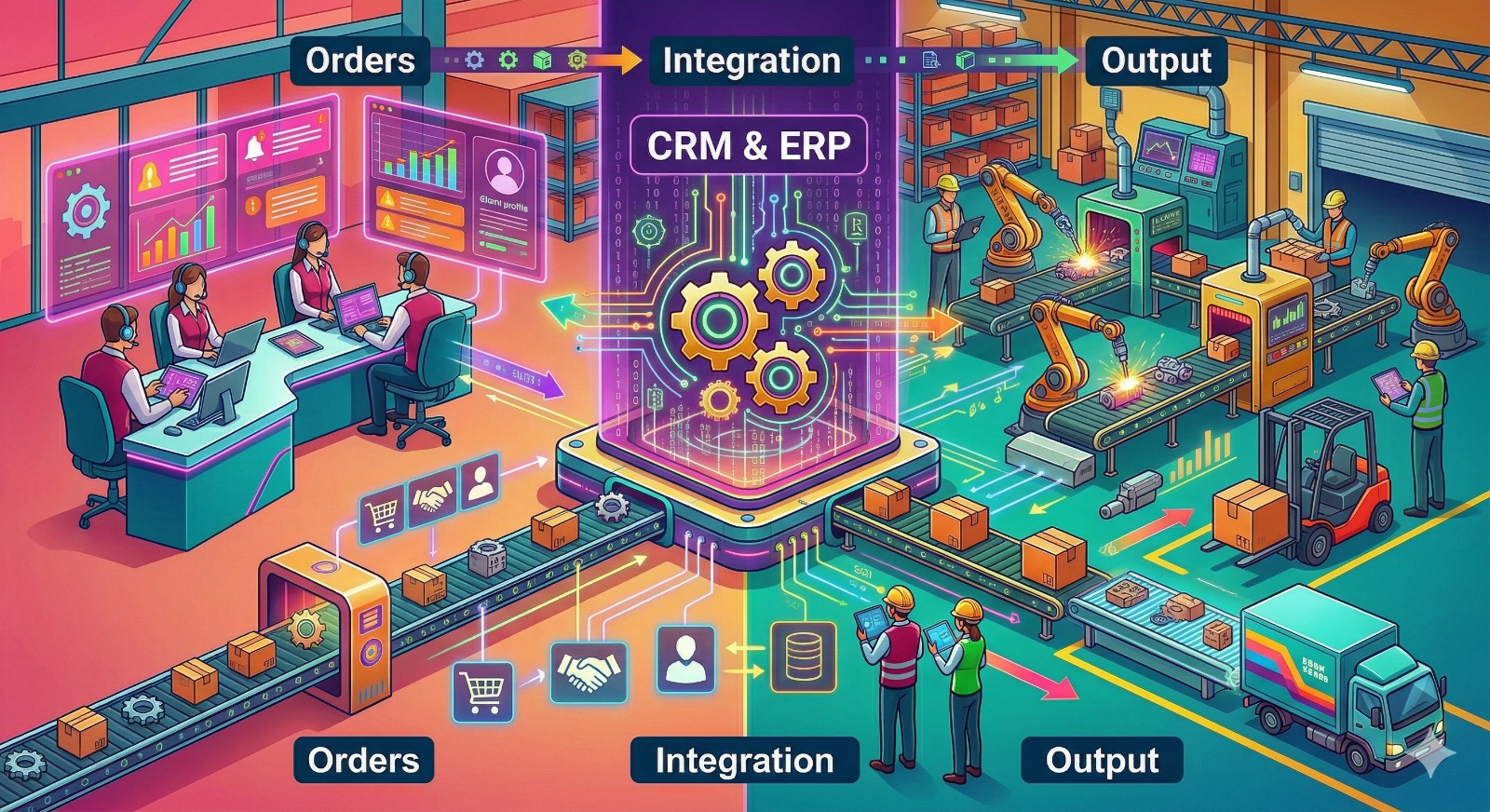
The Challenge: Disconnected Systems, Slower Decisions
Across many mid-sized manufacturing businesses, operations still run in silos. Customer orders are handled through emails or spreadsheets, while production teams rely on separate systems or manual tracking on the shop floor. Quality checks and customer feedback often remain isolated from core operations.
This lack of integration creates several challenges:
- Delayed responses to customer inquiries
- Inefficient production planning
- Limited visibility into order status
- Rising customer dissatisfaction
Even with strong demand and skilled teams, these gaps slow down operations and impact overall performance.
The Solution: A Unified CRM & ERP Approach
To overcome these challenges, an integrated CRM and ERP system brings all critical processes into one connected platform- bridging the gap between customer-facing activities and internal operations.
How the Integration Works
CRM manages:
- Customer orders and inquiries
- Complaints and feedback
- Real-time communication and tracking
ERP handles:
- Production planning and scheduling
- Inventory and material management
- Quality control processes
- Dispatch and billing
The real strength lies in seamless data flow-ensuring that information moves automatically between systems without manual intervention.
The Transformation in Action
With an integrated system in place, the workflow becomes streamlined and intelligent:
- A customer places an order → captured instantly in CRM
- The order flows automatically into ERP
- Inventory is checked and production is scheduled
- Live production updates sync back to CRM
- Customers receive real-time status updates
- Any complaints trigger immediate quality checks and root cause analysis
This creates a closed-loop system where every department works in sync.
The Impact: Measurable Business Results
Manufacturers adopting this approach typically experience:
- Up to 30% faster order processing
- Around 20% reduction in customer complaints
- Improved on-time delivery rates
- Stronger coordination between sales and production teams
Most importantly, decisions shift from guesswork to data-driven insights powered by real-time information.
What Sets This Approach Apart
Solutions like those offered by QeMFG stand out because they are:
- Designed specifically for manufacturing environments
- Focused on connecting shop floor operations with customer interactions
- Built for real-time visibility and control
- Flexible and scalable for growing businesses
Rather than just implementing software, the goal is to enable complete operational alignment.
Conclusion
In today’s competitive landscape, manufacturers cannot afford disconnected systems. By integrating CRM with ERP, QeMFG empowers manufacturers to align customer demand with production execution- creating faster, smarter, and more efficient operations. The future of manufacturing lies in connected systems- and with QeMFG, that future is already here.
Rushika Shah | Journalist
Ahmedabad