
 By themediahives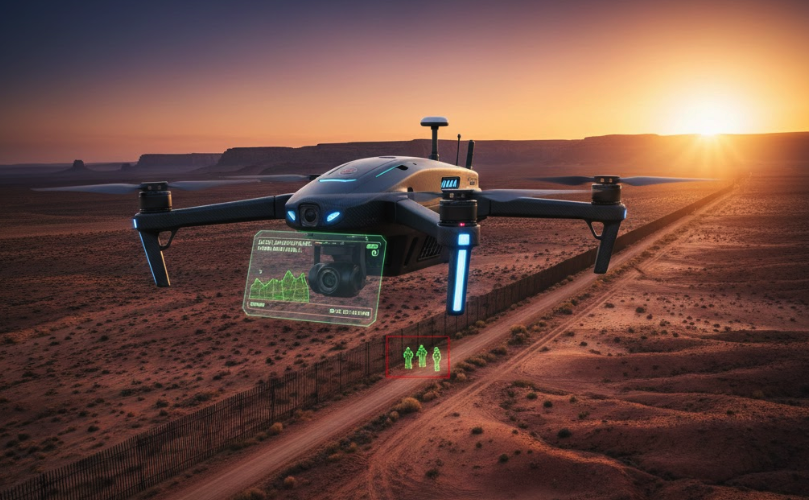
By Vision Raval, AI Expert
The global security landscape is undergoing a paradigm shift. As threats ranging from illegal migration to sophisticated smuggling operations become more complex, traditional border management—relying on manual patrols and static barriers—is reaching its limit. Artificial Intelligence (AI) is the catalyst for a new era of “Smart Borders,” offering the tools necessary to bridge the gap between vast, unmanageable terrains and limited human resources.
The AI Transformation: From Reactive to Proactive
The core value of AI in border security lies in its ability to process massive datasets in real-time, enabling automated decision-making and predictive threat detection. Unlike human operators who suffer from fatigue, AI systems provide persistent, 24/7 vigilance, reducing response times from minutes to milliseconds.
Key AI Technologies Driving Security
To achieve a “seamless” border, agencies are deploying a multi-layered technological shield:
-
Autonomous UAVs and Drones: Equipped with computer vision, these “eyes in the sky” patrol remote areas autonomously. They can distinguish between wildlife and human intruders, relaying high-definition thermal imagery to command centers.
-
IoT and Smart Sensors: Ground-based sensors integrated with the Internet of Things (IoT) detect subterranean vibrations or acoustic anomalies. These sensors act as a digital tripwire, triggering automated alerts the moment a perimeter is breached.
-
Biometrics and Facial Recognition: At legal ports of entry, AI-powered biometric corridors (such as the UK’s Border Force systems or U.S. CBP programs) cross-reference travelers against global watchlists. These systems can verify identity in under three seconds, streamlining legitimate travel while filtering out high-risk individuals.
Implementation Strategies: Building the “Digital Wall”
Successful AI integration requires more than just hardware; it requires a unified strategic framework.
-
Unified Command Systems: Platforms like Anduril’s Lattice integrate data from land, air, and sea into a single interface. This “sensor fusion” minimizes operator dependence and allows for autonomous tracking of targets across different surveillance assets.
-
Predictive Analytics: By analyzing historical breach data and seasonal migration patterns, AI can forecast where a crossing is likely to occur before it happens, allowing agencies to preemptively allocate personnel.
-
Pilot Testing: Agencies are increasingly using “sandbox” environments to test interoperability. For instance, U.S. Customs and Border Protection pilots new tools at specific ports to ensure they can communicate with legacy databases before a nationwide rollout.
Global Case Studies
The real-world efficacy of AI is already being proven by leading security agencies:
-
United States: CBP utilizes machine vision at ports to scan vehicles for hidden compartments and human presence with a precision far exceeding manual inspection.
-
United Kingdom: The Border Force uses AI-driven X-ray analysis to detect anomalies in freight, significantly reducing false alarms and speeding up the flow of trade.
-
Israel: Companies like Elbit Systems and Rafael have pioneered “persistent monitoring” solutions that use AI-driven reconnaissance to secure borders in highly volatile environments.
Navigating Ethical Challenges
Despite the benefits, the use of AI at borders raises critical ethical questions regarding algorithmic bias and privacy. If training data is not diverse, facial recognition can lead to discriminatory profiling.
Solutions for Responsible AI:
-
Human-in-the-Loop: AI should act as a “first stage review,” but final decisions regarding entry or detention must remain with human officers.
-
Transparency and Audits: Regular audits of AI algorithms ensure they remain accurate and free from bias.
-
Privacy-First Design: Implementing data anonymization and adhering to strict human rights impact assessments ensures that security does not come at the cost of civil liberties.
Conclusion
AI is not merely a tool for surveillance; it is the foundation of modern national resilience. By combining autonomous technology with ethical oversight, nations can create borders that are both impenetrable to threats and welcoming to legitimate global exchange.