 By themediahives
Article and Research By – Mr. Vision Raval
Virtual CEO, and AI – Future Tech Expert.
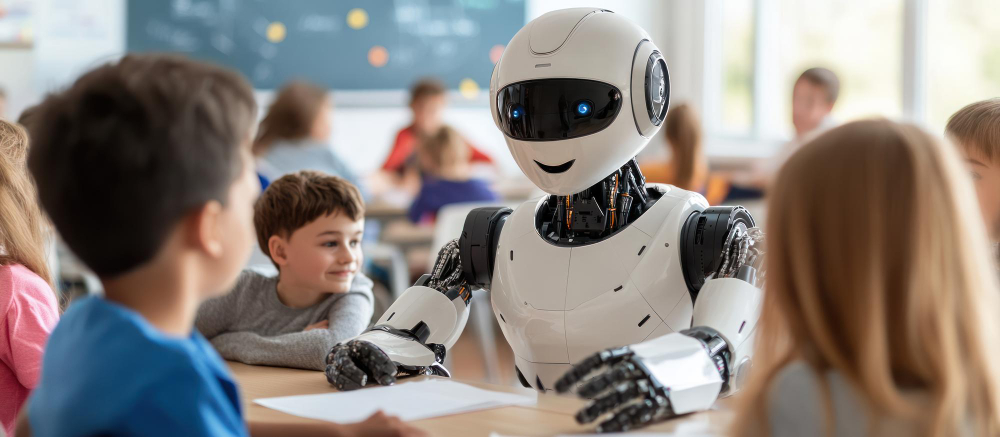
The education industry in 2026 is moving from passive lecturing to active participation, AI-supported personalization and immersive learning. For Grades 4 to 12, these new strategies are creating “phygital” classrooms where physical learning, digital tools and real-world application work together.
-
AI-Powered Hyper-Personalization
AI-powered learning is one of the biggest education trends of 2026. It comes from the growth of adaptive learning platforms, learning analytics and generative AI tools. Earlier systems only adjusted quiz difficulty, but today’s AI can track a student’s pace, mistakes, strengths, attention patterns and mastery level. The OECD’s Digital Education Outlook 2026 notes that generative AI is reshaping teaching and learning because it is widely accessible and easy to use. In classrooms, this means a Grade 6 student struggling with fractions may receive extra visual practice, while another student moves ahead to word problems. Teachers benefit too, because AI gives them instant insight into who needs help, who is ready for enrichment and where the whole class is slowing down. -
Flipped Classroom 2.0
The flipped classroom became popular through teachers such as Jonathan Bergmann and Aaron Sams, who began recording lessons around 2007 so students could watch them outside class. In 2026, this model has become more advanced: students study videos, simulations or AI-personalized modules at home, while classroom time is used for debate, experiments, peer learning and teacher-led problem-solving. A 2020 meta-analysis in Educational Research Review covering 198 studies and 33,678 students found that flipped classrooms had a positive effect on student performance, mainly because they create more time for structured active learning. For schools, this turns the classroom into a workshop rather than a lecture hall. -
Phygital Learning Spaces
The word “phygital” comes from combining “physical” and “digital,” and it first became popular in retail and marketing before entering education. In schools, phygital learning means physical classroom objects are enhanced through digital tools. For example, a science teacher can scan a circuit board, skeleton model or plant sample and project it onto a smart board for live annotation. Students can touch the real object while also viewing labels, data, 3D layers or AI-generated explanations. This approach is especially useful for Grades 4 to 12 because it connects textbook theory with visible, hands-on experience. -
Nano-Learning or Microlearning Capsules
Nano-learning comes from the broader idea of microlearning, which breaks content into small, focused units. Coursera defines microlearning as learning through short, bite-sized modules, often around five to ten minutes. In school classrooms, this has become even sharper, with two-to-five-minute capsules used to teach one concept at a time. Instead of a 40-minute lecture on photosynthesis, a teacher may divide it into capsules on sunlight, chlorophyll, carbon dioxide, oxygen release and plant energy. This method works well for Gen Alpha learners because it reduces cognitive overload and helps students feel quick progress. -
Immersive VR and AR Simulation
Virtual Reality and Augmented Reality are changing how students experience complex topics. Instead of only reading about the Indus Valley Civilization, students can virtually walk through a reconstructed settlement. Instead of watching a chemistry demonstration from a distance, they can perform a simulated experiment safely. PwC’s VR training study found that VR learners were up to four times more focused than e-learning students and 275 percent more confident to apply what they learned. While that study focused on enterprise training, the same principle is influencing school education: immersive experience improves attention, confidence and recall. -
Gamification 2.0
Gamification as a term is often credited to British programmer Nick Pelling in 2002, but game-like learning has existed for much longer. In 2026, schools are moving beyond badges and stars toward deeper game mechanics such as levels, quests, progress bars, leaderboards, missions and retry loops. A syllabus can be structured like a learning journey, where Chapter 1 becomes Level 1 and every assessment becomes a mission. The most important shift is psychological: students stop seeing mistakes as final failure and start seeing them as feedback for the next attempt. This builds resilience, motivation and a growth mindset. -
Transdisciplinary and Skill-Based Learning
Transdisciplinary learning is strongly associated with frameworks like the International Baccalaureate Primary Years Programme, which encourages students to learn across and beyond subject boundaries. In 2026, this approach is becoming more relevant because the job market values skills such as problem-solving, communication, critical thinking, digital literacy and collaboration. A topic like climate change may include science, geography, mathematics, economics and persuasive writing. Students do not simply memorize facts; they learn how different subjects connect to real-world issues. This is why many schools are shifting from “What chapter did you complete?” to “What problem did you solve?” -
Social-Emotional Learning Integration
Social-Emotional Learning, or SEL, was formally advanced by CASEL, the Collaborative for Academic, Social, and Emotional Learning, which was formed in 1994. SEL focuses on self-awareness, self-management, social awareness, relationship skills and responsible decision-making. In 2026, this has become more important because AI can support academic tasks, but human skills still need human practice. Schools are using check-ins, reflection circles, peer collaboration and well-being dashboards to understand student stress and engagement. The Education Endowment Foundation reports that SEL approaches can add around three months of academic progress on average, while also improving attitudes, relationships and emotional regulation. -
Project-Based Learning with Global Reach
Project-Based Learning has roots in the work of William Heard Kilpatrick, who published “The Project Method” in 1918, and it was influenced by the educational philosophy of John Dewey. Today, organizations like PBLWorks define PBL as learning through extended, real-world and meaningful projects. In 2026, digital collaboration tools such as Miro, Trello, Google Workspace and Microsoft Teams are giving PBL a global reach. Students may design a sustainable city, create a business plan, develop a community awareness campaign or solve a local waste-management issue. This method builds creativity, teamwork and communication because students produce something real for a real audience.
-
Metacognition: Thinking About Thinking
Metacognition was popularized by American developmental psychologist John Flavell in the 1970s and is commonly described as “thinking about thinking.” In schools, it means teaching students to plan, monitor and evaluate their own learning. A student may ask: What do I already know? Where am I stuck? Which strategy worked? What should I try next? Tools such as reflection journals, learning logs, goal sheets and self-assessment rubrics make this process visible. The Education Endowment Foundation rates metacognition and self-regulation as a high-impact, low-cost strategy, with an average impact of around eight additional months of progress when implemented well.
These 10 strategies show that the classroom of 2026 is becoming more active, personalized and skill-focused. Technology is not replacing teachers; it is changing their role. The modern teacher is becoming a mentor, designer, facilitator and emotional guide who helps students learn not just information, but how to think, collaborate, adapt and solve real-world problems.
Sources Referenced: OECD Digital Education Outlook 2026, CASEL, Education Endowment Foundation, PBLWorks, International Baccalaureate, PwC VR Learning Study, and flipped classroom research linked to Jonathan Bergmann and Aaron Sams.