
 By themediahives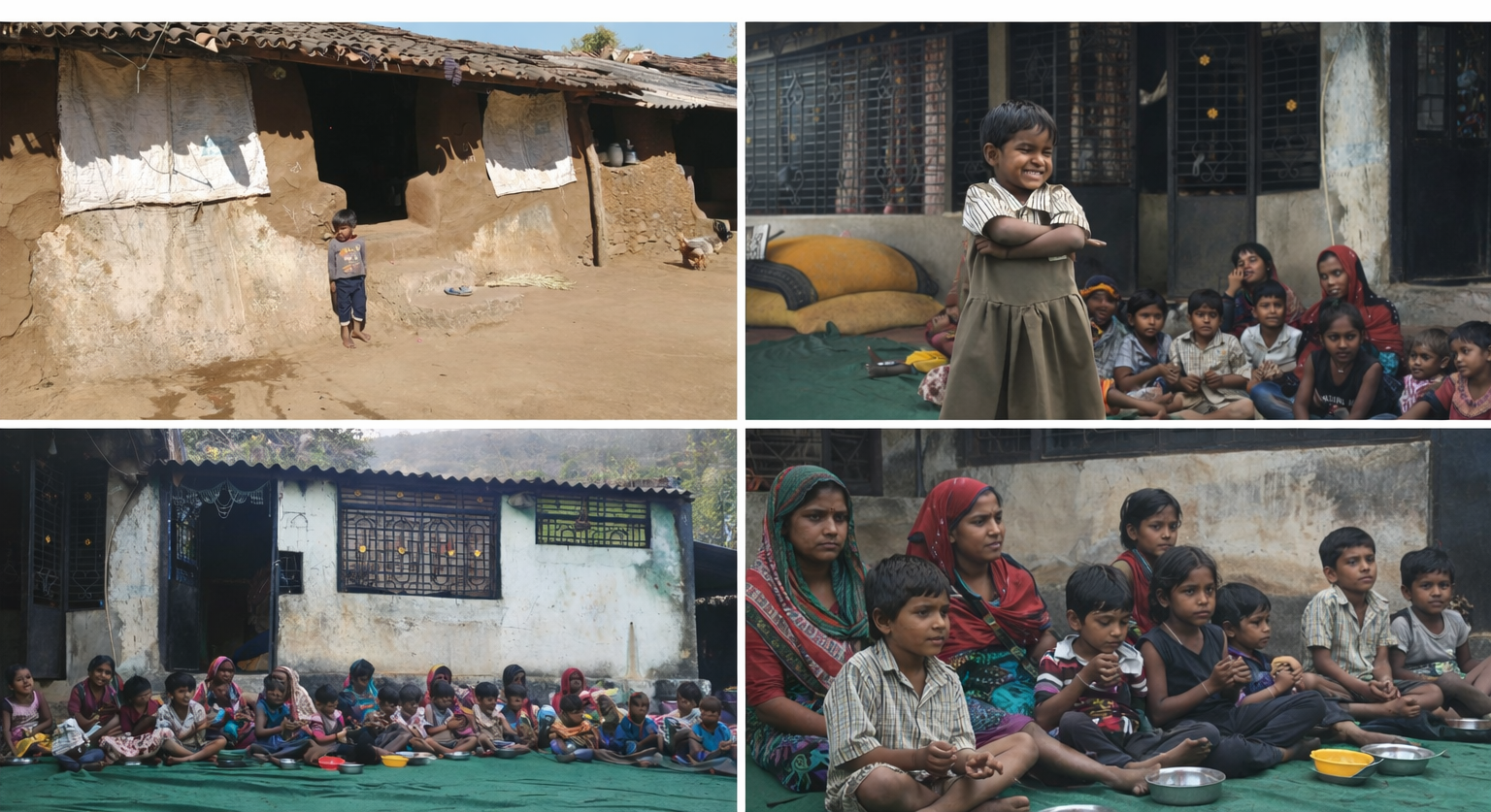
Article By- Ajay Upadhyay
There is a temptation in journalism especially among the young to look for noise: breaking news, dramatic visuals, sharp binaries. After four decades in newsrooms, one learns a different lesson. The most consequential crises are often the least visible. They unfold slowly, resist spectacle, and rarely announce themselves as emergencies.
Child malnutrition in India belongs firmly in this category.
As a student of Mass Communication and Journalism, I encountered this truth not through an official press release or a policy document, but during an NGO internship in Banaskantha district of Gujarat. What I witnessed there when read alongside national and global data underscores a reality the media has struggled to confront adequately: India’s nutrition crisis is no longer only about hunger. It is increasingly about diet quality, awareness, and the silent spread of ultra-processed food.
Journalism Education and the Discipline of Seeing Clearly
Formal journalism education, at its best, does not merely teach skills. It instils habits of mind: scepticism without cynicism, empathy without sentimentality, and an insistence on evidence over assumption.
In the classroom, concepts such as agenda-setting, framing, and media silence can appear abstract. In practice, they explain why some issues dominate public discourse while others no less urgent remain marginal. Malnutrition, particularly in its less visible forms, has long suffered from this marginality.
What drew my attention during my postgraduate course was not the absence of food in rural India, but the absence of sustained attention.
The Field Experience: When Normalcy Masks Deprivation
Banaskantha is not a place that announces crisis. Children attend school. Shops are stocked. Meals are cooked. Government nutrition schemes exist. Anganwadi centres function.
Yet a closer look reveals a troubling pattern.
During a structured field survey of 18 families conducted as part of my internship with Janpath NGO, a striking finding emerged: every family reported that their children consumed packet or ultra-processed food daily.
This was not a matter of occasional indulgence. Chips, biscuits, instant noodles, and sugary drinks had become routine components of children’s diets often consumed before meals and frequently replacing home-cooked food altogether.
This single data point is revealing not because of its novelty, but because of its consistency.
From Field Observation to National Pattern
What appeared in Banaskantha mirrors trends documented by national and global agencies.
According to the UNICEF–WHO–World Bank Joint Child Malnutrition Estimates, approximately 150 million children globally are stunted, while over 42 million are wasted. India accounts for a disproportionate share of this burden. Roughly one in three Indian children under five is stunted, and nearly one in five is wasted, placing India among the worst-affected countries worldwide.
Gujarat’s record, often overlooked amid narratives of economic progress, is sobering. Recent state data indicates that over 5.7 lakh children are malnourished, with stunting rates ranging between 36% and 40% in several districts, including Banaskantha. Anaemia affects more than 60% of women, compounding nutritional deficits across generations.
These figures do not describe a failure of food availability alone. They point to a deeper, more complex failure.
The New Face of Malnutrition: Eating Without Nourishment
The World Health Organization has repeatedly warned of what it terms the “double burden of malnutrition” — the coexistence of undernutrition and diet-related non-communicable risks driven by ultra-processed foods.
In Banaskantha, this global phenomenon is visible at close quarters. Children eat regularly, yet their diets are dominated by foods high in sugar, salt, and unhealthy fats, and critically low in essential nutrients. Parents, acting under economic and time constraints, choose what is affordable, available, and accepted by children.
This is not neglect. It is adaptation.
The result is what health experts call hidden hunger — a condition where caloric intake masks micronutrient deficiency, leading to impaired growth, weakened immunity, and diminished cognitive development.
Awareness: The Weakest Link in the Chain
Perhaps the most telling finding from the field was the limited awareness among parents regarding the long-term consequences of packet food consumption. Packaged food was widely perceived as safe, even beneficial, by virtue of its branding and availability.
Government schemes focus largely on distribution — supplementary meals, take-home rations, fortified foods. What they often fail to address with equal seriousness is behavioural change communication.
Corporate food marketing, by contrast, reaches even the most remote villages with remarkable efficiency.
This asymmetry matters.
Media Silence and Its Consequences
For a profession that prides itself on vigilance, journalism has been uneven in its attention to slow-moving crises. Malnutrition does not lend itself to immediacy. It does not erupt; it accumulates.
Yet the long-term consequences — on education, productivity, public health, and inequality — are profound. WHO estimates consistently show that countries failing to address childhood malnutrition incur heavy economic and social costs over time.
The absence of sustained coverage is not neutral. It shapes public priorities and policy urgency.
Ethics Beyond Abstraction
Field reporting on malnutrition raises ethical questions that cannot be resolved through doctrine alone. How does one document deprivation without exploiting it? How does one convey urgency without sensationalism?
In Banaskantha, restraint proved more instructive than exposure. Observation, explanation, and context mattered more than images that shock but do not endure.
Ethical journalism, particularly on issues involving children, demands patience — and humility.
What Journalism Education Ultimately Teaches
The value of journalism education lies not in producing instant commentators, but in cultivating discernment. It teaches the discipline of connecting global data with local realities, and of resisting easy narratives.
The field experience in Banaskantha gave substance to the numbers published by WHO and national agencies. The classroom provided the analytical tools to interpret both responsibly.
Together, they offered a clearer view of a crisis that remains inadequately understood.
Conclusion: The Responsibility of Attention
India’s malnutrition challenge is not confined to poverty alone. It reflects the changing nature of food systems, the power of marketing, gaps in awareness, and the limitations of communication strategies.
Children in Banaskantha eat every day. So do millions across India and the world. And yet, many remain undernourished.
For journalism, the task is neither to exaggerate nor to avert its gaze. It is to pay sustained attention to what unfolds quietly — and to insist that such realities matter.
After four decades in journalism, one learns that the most important stories are rarely the loudest. They are the ones that require us to look carefully, think patiently, and speak with restraint.