
 By themediahives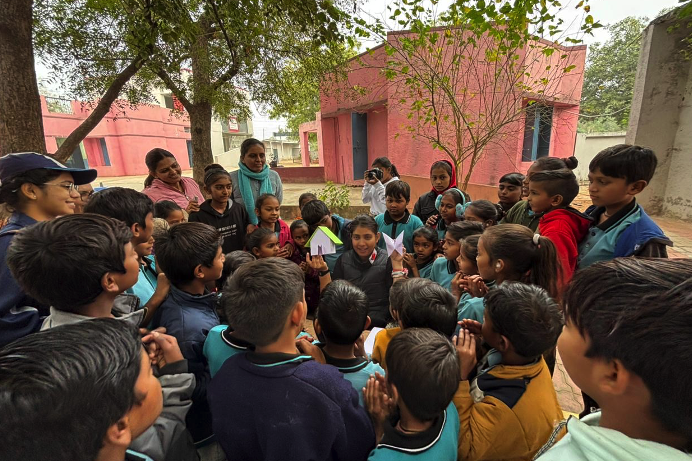
By— Sumaiya Shekhani,
(Master’s in Development Communication)
In a world where birthdays are increasingly measured by restaurant reservations, social media stories, and the perfect photograph of a cake being cut, it is easy to forget that some of the most meaningful celebrations are the quiet ones those that do not rely on decoration, budgets, or big plans. Sometimes, all it takes is a sincere intention, a few curious minds, and a classroom full of children to turn an ordinary date on the calendar into a memory that lasts for years.
That is exactly what happened on 28 Dec, 2024 in Rajpur, a small village in Gandhinagar district, near Ahmedabad, Gujarat, where a young woman pursuing a Master’s in Development Communication chose to spend her birthday in a way that was both unusual and deeply inspiring. She visited a government school (Anganwadi) not only to share her love for photography, but also as part of a practical field-learning visit with her classmates.
In fact, the visit to Rajpur was a learning step for the master’s students themselves. As part of their academic journey, the Master’s degree students were learning photography under the guidance of Ketan Modi Sir, and the Rajpur visit was planned specifically so they could understand photography practically in the field beyond classroom explanations by observing light, composition, subjects, and storytelling in an authentic environment. The day became a rare blend of two kinds of learning happening at once: the master’s students learning photography practically, and the school children discovering photography with fresh excitement.
This story also holds a larger context. Across India, Anganwadi forms one of the most widespread early childhood and community level learning and nutrition support systems. Total 13.96 lakh Anganwadis are registered under the Poshan Tracker application as of 30th June 2023 which are run by the government in India. This makes every Anganwadi not only a local learning space, but also a part of a massive national network that quietly supports children and families every day. Yet, despite being such an important backbone, the children who study in these spaces are often not seen for their potential. Many of them are highly talented—sharp, creative, eager to learn but they get overshadowed, mostly because they come from rural settings where opportunities and exposure are limited, and because society still tends to notice “privilege” faster than it notices “promise.”
And it was within one such space in Rajpur that an ordinary birthday turned into something extraordinary.
The workshop was conducted under the guidance of Ketan Modi Sir, who led the photography session and helped both the master’s students and the children understand the art and basics of visual storytelling. The group came to learnbut they returned with something far more valuable than photographs: a lesson in warmth, community, and the kind of joy that can only be found when learning becomes a shared experience.

A Birthday with a Purpose
The visitor an aspiring photographer and a student of Development Communication had long believed that photography is more than an art form or a hobby. To her, it is a language: a way of telling stories without words, a way of noticing details that life often rushes past, and a way of preserving moments that deserve to be remembered. Over time, she also began to see photography as a tool for confidence especially for children. When a child learns to take a photograph, they don’t just learn how to press a button; they learn how to look, how to observe, how to decide what matters in a frame.
On her birthday, she wanted to do something that felt meaningful something that connected her passion with a larger purpose. A village school workshop, she felt, would be the perfect way to do that. It would allow her to share basic photography skills with children who may not have had the opportunity to explore the art in a structured way. It would also give her a chance to step into a new environment and understand the everyday world of students in rural Gujarat children whose lives are often full of responsibility, resilience, and quiet ambition.
At the same time, for the master’s students, this was also a learning moment. When photography is taught only theoretically, it can feel like a set of rules. But when you step into the field, it becomes an experience. Light behaves differently outdoors than it does inside classrooms. People move unpredictably. Backgrounds become complex. Moments appear and disappear quickly. This is where photography becomes real and this is exactly why the group visited Rajpur.
The Morning at the Government School (Anganwadi) in Rajpur
The village of Rajpur was calm when the group arrived quiet lanes, open skies, and the gentle rhythm of a day beginning. Like many rural learning spaces, the government school (Anganwadi) campus was simple and functional. There were modest rooms that served as learning spaces, a corridor area, and an open section where children could gather comfortably. The atmosphere carried that familiar energy of childhood curiosity, movement, quiet laughter, and the anticipation of something different from the regular timetable.
But what made the place instantly special was the welcome.
From the moment they stepped inside, they were received not as outsiders but as guests whose presence mattered. The children greeted them with folded hands and bright eyes. Their politeness wasn’t forced; it was natural, flowing from a culture of respect that is often deeply rooted in rural communities.

And then came something no one had expected: the Anganwadi students welcomed the group with handmade cards crafted with their own creativity. Simple sheets folded carefully, decorated with coloured pencils and small drawings, carrying warm messages in their own way these cards instantly turned the atmosphere softer and more personal. It was not a grand gesture, but it was a powerful one. In that moment, it became clear that the children here were not lacking talent at all they were full of expression. They were only lacking platforms.
Some students looked excited, some looked shy, and some stood a little behind others, observing silently yet all of them shared the same curiosity: Who are they? What will they teach us? What is this camera?
For the master’s students, even this welcome became a moment to observe expressions, gestures, the play of light on faces, the natural storytelling present in a simple scene. This is what field learning does: it trains you to notice. And as the day progressed, it became clearer that the children here were highly capable quick, confident, and eager to learn.
A Tour Led by Pride
Before the workshop began, the students insisted on showing them their school thoroughly. This wasn’t a formal tour it was a proud introduction to a place they considered their own. They led them to their learning spaces, pointing out small details with genuine excitement. They showed their boards and explained which lessons they were currently studying. Some students spoke about their timetable and their favourite subjects, while others proudly pointed out displays of drawings and handwritten work.
They also showed the open area where they gather for morning prayer and activities. Every corner carried a sense of routine and belonging. The pride was visible—not because the infrastructure was grand, but because the space represented learning, friendship, and the daily rhythm of their lives.
For the master’s students, this tour was also a field lesson: how children describe their environment tells you what they value. And what they valued most was not what the school looked like it was what the school meant to them.
The Workshop Begins: Learning to See
When it was time to begin, Ketan Modi Sir gathered the children of Classes 5 to 7 together and introduced them to photography in the simplest way possible: by telling them that a photograph is a story.
“Every photo shows something,” he explained. “But the best photos also make you feel something.”
He began with the basics. He spoke about light—how morning light is soft, how shadows create depth, and how the sun can change a picture without changing the subject. He discussed framing—how deciding what to include and what to leave out is a kind of decision-making that photographers learn over time. He talked about angles—how a small change in position can completely change what a picture communicates.
Then, he connected the lesson to the field. He encouraged the master’s students to observe the surroundings like photographers: notice the direction of sunlight, notice where shadows fall, notice how the background can either strengthen or distract from the subject. This was not just a workshop for children; it was also a live classroom for the master’s students.
The master’s student and her classmates supported the session—encouraging children, guiding them while they practiced, and making sure every child got a chance to hold the camera and try. They gave the children simple rules: hold the camera steady, focus on one subject, look at the background, and always think about what you want your photo to say.
Then came the most exciting part: practice.

Children Behind the Camera
As the camera moved from hand to hand, the children’s expressions changed. Some became intensely focused, brows furrowed in concentration. Some giggled when they tried to take a picture and accidentally captured a friend’s half-visible face. Some were hesitant, holding the camera carefully as if it were something precious. A few were naturally confident, quickly understanding how to frame a shot and asking questions like, “Sir, should I stand here or there?” and “How do I make the photo look better?”
The group encouraged them gently. Nobody corrected them harshly. Instead, they guided them with questions: “What are you trying to show in this picture?” “Where is the light coming from?” “Do you want the photo to feel happy or serious?” “Can you take it again from a different angle?”
And alongside the children, the master’s students were also learning seeing how fast moments change, how quickly expressions shift, how the best shots come when you are alert. For them, this was the practical learning they had come for: not perfect studio photographs, but real-world photography where every second matters.
What stood out most was the children’s natural eye. They were quick to understand what looked good, quick to experiment, and quick to improve. Their talent was visible in the way they observed, framed, and asked questions. It was a reminder that rural students are not “less capable” they are often simply less visible and therefore get overshadowed.
The Unexpected Discovery: It’s Her Birthday
In the middle of the workshop, during a casual conversation, her classmates and Ketan Modi Sir began chatting with the children. In that flow, one of her friends mentioned that it was her birthday, and Ketan Sir gently confirmed it to the students, smiling as he looked around the room.
At first, the children went silent, as if the information needed a moment to sink in. Then, like a spark catching fire, excitement spread. Whispers moved through the group. Eyes widened. Smiles appeared. Within moments, the atmosphere changed completely from learning-focused curiosity to joyful celebration.
The visitor hadn’t expected anyone to make an announcement. She hadn’t mentioned it herself, and she had not planned anything around it. But the moment her friends and Ketan Sir shared the news, the students treated it like a festival warm, spontaneous, and full of genuine happiness.
“We Will Celebrate!”
The children insisted that they wanted to celebrate her birthday in their style.
There was no cake. No candles. No balloons. But there was something much better: a sincere desire to make her feel special.
The teachers smiled, allowing the moment to unfold. The students began discussing among themselves what they could do. Some clapped. Some volunteered to sing. Some wanted her to sit in the centre like an honoured guest.
And then, with that uniquely Indian spontaneity especially common in school settings—the celebration took shape naturally.

A Gujarati Birthday Song, Full of Heart
The children gathered together and began singing a birthday song in Gujarati. Their voices filled the space sweet, enthusiastic, slightly uncoordinated, yet completely heartfelt. Some children clapped in rhythm. Some sang loudly. Some sang softly, smiling shyly. A few forgot lines and laughed, but they continued without losing the spirit.
The visitor sat there, deeply moved. She smiled, and her eyes softened with emotion. In that moment, the workshop and the birthday merged into one powerful experience: a day of learning and a day of connection.
It wasn’t the language of the song that mattered most it was what the song represented. A room full of children, many from backgrounds where resources are limited, chose to offer their warmth freely. They celebrated her not with objects, but with effort and affection.
A Celebration That Teaches
The beauty of that moment was that it wasn’t just a celebration for her. It was also a lesson for the students.
They learned that birthdays are not only about receiving. They can also be about giving.
They learned that a teacher or guest is not distant; they are human beings who can be appreciated.
They learned that kindness is powerful.
And the visitor, in return, learned that education is not always a formal process. Sometimes, the most unforgettable learning happens when barriers drop and people simply meet each other with sincerity.
More Than a Workshop
By the time the day came to an end, the visitor realised she had taken many photos—but the most meaningful images were not necessarily in her camera.
They were in her memory: children showing their learning space with pride, children holding the camera carefully, children laughing as they tried new angles, children offering handmade cards with pure creativity, and children singing in Gujarati to celebrate a birthday they had no reason to celebrate except kindness.
The government school (Anganwadi) in Rajpur, with its simplicity, offered something profound: a reminder that learning is alive when it is shared. That creativity doesn’t require luxury. The best classrooms are those where people feel respected and valued.
The Larger Message
In discussions about education, we often focus on infrastructure, curriculum, and performance metrics. These matter, of course. But this workshop in a village learning space also reminds us of something equally important: the human spirit within education.
When children are given opportunities to explore creativity, they respond with enthusiasm. When they are treated with respect, they respond with generosity. When someone visits them not as a “charity gesture” but as a genuine exchange of learning, they respond with dignity and pride.
And perhaps most importantly, it shows that government schools and Anganwadis are not merely institutions they are communities. They hold not only students and teachers, but also stories, dreams, and immense potential. The children here are talented often exceptionally so but without exposure, they remain overshadowed. Moments like this workshop act like a spotlight, briefly but powerfully showing what can happen when talent is given a chance.
A Birthday Remembered
As the visitor prepared to leave, the children gathered around once again, waving goodbye, asking when she would return, and smiling as if they had known her for much longer than a few hours. The teachers thanked her classmates and Ketan Modi Sir for the workshop. She thanked them for the warmth she had received.
On the way back, she looked at the photos on her camera. The images were good—some even excellent. But what stayed with her wasn’t the technical outcome. It was the feeling of that Anganwadi, the sound of that Gujarati birthday song, and the reminder that meaningful moments often come when we choose to share our skills in places where they can spark new confidence.
Her birthday, spent in a government school (Anganwadi) in Rajpur, Gandhinagar district, on 28 Dec, 2024, became more than a personal milestone. It became a story of connection—where learning and celebration met in the same frame.
Through the lens of learning, she came to learn photography.
Through the heart of a village, she received a birthday she would never forget.
Citation –
https://www.pib.gov.in/PressReleasePage.aspx?PRID=1943759®=3&lang=2