
 By themediahives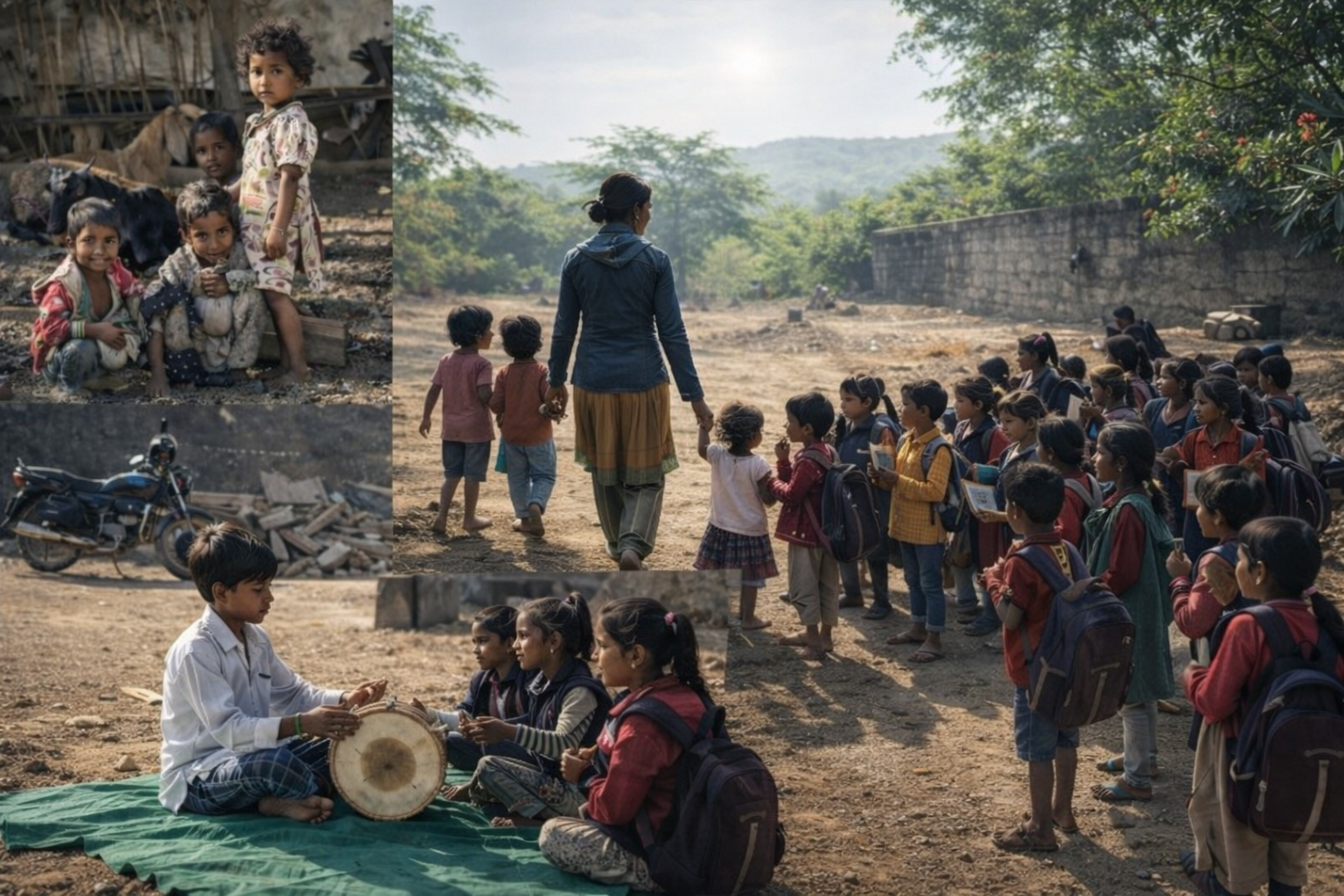
Stepping out of the bustling city into the quiet heart of rural Gujarat, I experienced a world that felt at once simpler and richer, harsher yet fuller in its own way. As part of my academic training in the Department of Mass Communication and Journalism, I participated in a rural internship organized in collaboration with Janpath NGO—a community-based organization devoted to improving education, health, and women’s welfare in underprivileged villages. The internship, spread across several villages like Nani Tundiya, Vekri, Sekda, and Chorasana, offered a window into the everyday lives of rural communities. What struck me most was not just the challenges these communities face but the profound sense of happiness and contentment that seems woven into their daily lives—a stark contrast to the hurried, disconnected existence I see in the city.
Village Life: A Different Rhythm of Happiness
At first glance, the villages seemed small, unassuming, and even impoverished by city standards. Most homes were modest, infrastructure was basic, and the economic hardships were obvious. Many families survived on the income of a single breadwinner, supporting large households, and children often walked barefoot to school, covering long distances. Malnutrition, irregular ration supplies, and limited access to clean water or healthcare were common. Yet, amid these difficulties, I noticed something remarkable: a quiet, enduring happiness in the lives of the villagers.
In the villages, people take the time to interact. When we visited homes to conduct surveys, mothers and children welcomed us warmly, sharing their stories and daily struggles. Conversations weren’t rushed; there was a sense of community that made time seem abundant, in contrast to the constant hurry of city life where people barely glance at each other. Children played freely, engaged in productive activities rather than scrolling through social media or video games. They sang, drew, and learned together, often helping in household chores or agricultural work. Life in the village seemed more connected to nature, the seasons, and a communal rhythm that nurtures both body and spirit.
This environment fostered a form of happiness I had rarely seen in urban life. It was not the kind of happiness that comes from material wealth, flashy gadgets, or social media validation. Instead, it was rooted in relationships, shared responsibilities, and a close connection with the natural world. People smiled easily, valued simplicity, and celebrated small joys—like a fresh meal, a communal festival, or a child’s first steps in school.
Education Beyond Infrastructure
During visits to Vekri and Sekda schools, I noticed that education in villages is not just about textbooks — it is about dedication against odds.
At Vekri School, students began their day by cleaning classrooms and preparing for prayers. The discipline of these young children, many of whom walked long distances, was inspiring. The teachers, led by Principal Narendra Bhai, worked tirelessly to maintain attendance and quality learning despite scarce resources.
In contrast, Sekda School faced severe infrastructural challenges. All classes from Grades 1 to 5 were held under a temporary shade due to incomplete construction. Yet, I found the student’s energy undiminished. They laughed, played, and learned with undivided attention. We played games together, and for those moments, there was no distinction between a city student and a village child — only shared joy.
I realized that education in rural India is powered by resilience — by the commitment of teachers and the hunger to learn among children, even when the environment is not ideal.
Poverty and Pain: The Other Side of Rural Life
While the village exudes simplicity and warmth, it is also marked by hardship and inequality. During our household surveys in Nani Tundiya and nearby villages, I saw how poverty continues to shape lives in heartbreaking ways.
In many homes, a single breadwinner supports eight to ten family members. In some, government ration cards were either missing or irregularly updated, leading to months without sufficient food supply. Malnutrition was visible — thin children with dull eyes and pale skin, mothers who looked much older than their age, and families surviving on little more than khichdi and tea.
One case that deeply moved me was that of a 27-year-old pregnant woman who had lost two of her five children due to lack of medical care. Her story revealed the intersections of poverty, illiteracy, and neglect, where maternal health often takes a back seat.
It was painful to see that alcoholism is also a coping mechanism for some — a result of unemployment, hopelessness, and lack of awareness. I was disturbed to learn that in certain homes, even children were occasionally exposed to drinking. Poverty, thus, is not just the absence of money; it is the absence of opportunity, guidance, and support.
Women: The Unsung Pillars of Rural India
If there is one force keeping the villages alive and thriving, it is the women.
Women like Kailash Ben and Toral Ben manage community centers, care for children, monitor nutrition levels, and educate mothers about hygiene and health — often with limited resources and little recognition. Their quiet strength and sense of duty inspired me deeply.
During my interaction with them, I understood that rural development begins with empowering women. When women are educated and supported, children stay healthier, families manage resources better, and communities become more stable.
These women represent hope — they are the bridge between government policies and real impact on the ground. Their role is not just operational; it is transformational.
Children Without Screens: Rediscovering Real Play
One of the most striking differences between village and city life is the absence of social media. Children in villages don’t scroll through phones or watch endless videos. Instead, they climb trees, draw in the sand, help their parents, or play games with friends.
At the Anganwadi in Nani Tundiya, I spent some time teaching Gujarati letters and numbers. The children’s attention span, curiosity, and creativity amazed me. They did not need digital stimulation; they had nature, community, and imagination.
In contrast, city children — despite having better schools and gadgets — often struggle with loneliness, distraction, and stress. The village reminded me that childhood is meant to be about exploration, not expectation.
A Contrast: City Rush vs. Village Rhythm
City life and village life are two different worlds — each with its own rhythm.
In cities, people chase success; in villages, people chase the next harvest. Cities are filled with artificial light; villages glow under the stars. City people have more access to resources, but less access to peace.
In my observation, city dwellers live faster but feel emptier. We are constantly connected online but disconnected emotionally. In villages, people may have less, but they have each other. They eat together, celebrate together, and face problems collectively.
The concept of time itself feels different. In cities, time is money. In villages, time is life — measured not by minutes but by moments. That, I realized, is the real essence of happiness.
Learning Beyond the Classroom
My internship taught me lessons that no textbook could.
I learned that poverty is multidimensional — it is not only financial but also emotional and informational. I realized the importance of communication — how trust must be earned before people share their stories. Some women hesitated to speak during surveys, fearing judgment or gossip. It taught me patience and empathy.
Walking 7–10 kilometers daily across villages tested my endurance but also showed me the strength of teamwork and adaptability. We shared meals with locals, sat on floors, and listened to their dreams. Despite their struggles, people smiled easily — a reminder that happiness is not proportional to wealth.
Above all, I discovered the power of small actions. A bowl of nutritious food, a song, or a kind conversation can make a visible difference in someone’s day. That realization changed me — both as a student and as a human being.
Media and Storytelling for Change
As a student of Mass Communication and Journalism, this internship opened my eyes to the power of storytelling in social change. Behind every statistic of malnutrition or illiteracy is a real face, a real story waiting to be told.
The challenge lies not only in collecting data but in communicating these realities to a wider audience — policymakers, educators, and urban citizens who often live in a bubble of privilege.
I now feel a deep sense of responsibility to use my skills in media, writing, and photography to amplify rural voices — to bridge the gap between city ignorance and rural resilience. Every photo, every report, every article like this one can be a window into another world — a world that is equally part of India, yet often forgotten.
Personal Reflection: What Happiness Really Means
When I returned from my rural internship, I found that living a peaceful life in village is far better than living in city. The noise, the rush, the constant digital chatter — everything felt overwhelming. I missed the quiet mornings, the smell of wet soil, the children running barefoot, and the genuine smiles of villagers.
It made me question: What is happiness?
In cities, happiness often feels conditional — tied to achievement, appearance, or possessions. But in the village, happiness is unconditional — born from connection, gratitude, and contentment. People there may not have much, but they are present in their lives. They laugh together, cry together, and stand by each other.
That’s a kind of wealth we’ve lost in urban life.
Challenges and Hopes
Of course, rural life is not without its challenges. Poverty, poor infrastructure, malnutrition, alcoholism, and gender inequality continue to haunt progress. But these problems are not reasons for despair — they are calls for action.
Organizations like Janpath NGO are living proof that change is possible. Their grassroots programs — especially Nashta Fadiyu and Anganwadi support — show how consistent local engagement can uplift entire communities.
If city youth like us step into these spaces more often, bringing creativity, media awareness, and fresh energy, we can help rural India grow without losing its essence. Development must not mean urbanization; it must mean dignity, opportunity, and balance.
Conclusion: Lessons Beyond the City Lights
My internship with Janpath NGO was not just a professional assignment; it was a journey of transformation. It taught me that development is not only about building roads or schools but about building relationships, empathy, and awareness.
Beyond the city lights, in the quiet fields of Gujarat, I found lessons in humanity that no city could teach. The villagers, with their simple hearts and resilient spirits, showed me what it means to live — not just to exist.
As I continue my journey in mass communication, I carry with me the smiles of those children, the dedication of the women, and the unspoken wisdom of rural life. Happiness, I learned, is not about where you live — it’s about how you live.
- Rushika shah