
 By themediahives
Article by
– Vidhi Rajput – Journalism
(Gujarat University)
Education is often described as the most powerful tool for social change, yet for countless girls in rural India, this tool is taken away far too early. Beyond Class 8, when dreams should begin to take shape and confidence should grow, many girls instead face an abrupt halt to their education. Their schoolbags are replaced with household responsibilities, and their aspirations are silenced by early engagements. This article explores this harsh reality through the lived context of a rural family from Malna village, Kativas-1, Danta taluka, Banaskantha district, Gujarat, highlighting how poverty, distance, and lack of opportunity collectively push young girls out of classrooms and into premature adulthood.
Rural Reality and the Weight of Poverty :-
In villages like Kativas – 1 life revolves around agriculture. Families depend heavily on farming, an occupation that is seasonal, unpredictable, and deeply tied to nature. The income earned from fields fluctuates with rainfall, soil conditions, and market prices. For many households, survival itself is a daily challenge, making education feel like a distant luxury rather than a necessity.
The family of Manaji Bhai Amit Ji, a farmer by occupation, reflects this reality. His hard work in the fields is the primary source of income, while Nita Ben Manaji Bhai, a homemaker, manages the household and cares for the family. Despite their efforts, limited financial stability makes long-term investment in education extremely difficult. When resources are scarce, families are often forced to prioritize immediate needs food, shelter, and basic survival over school fees, transportation, uniforms, and books.
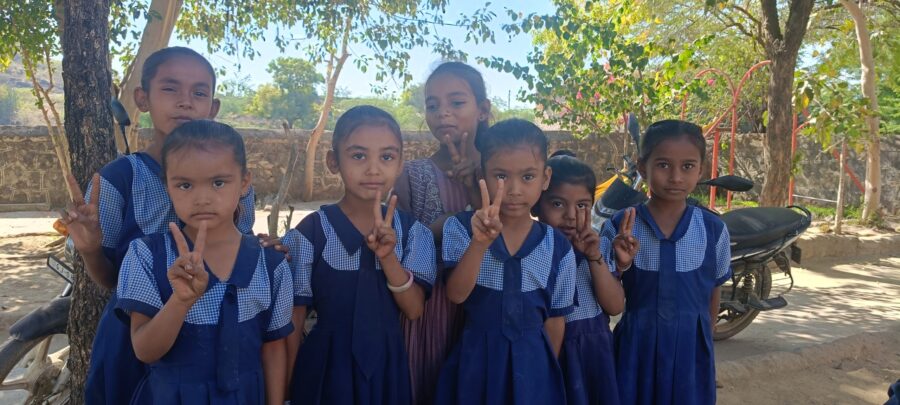
In such circumstances, educating daughters beyond the basic level is often seen as an unnecessary burden. Social norms further reinforce this belief, quietly suggesting that a girl’s ultimate role lies within marriage rather than education or employment.
Profile of the Respondent: A Young Dream Interrupted
| Name: | Thakur Aarushi Ben Manaji Bhai |
| Age: | 14 years |
| Village: | Kativas – 1 |
| Taluka: | Danta |
| District: | Banaskantha, Gujarat |
At just 14 years of age, Aarushi stands at a critical crossroads of life. She represents thousands of girls whose dreams are fragile, shaped by hope yet threatened by circumstance. Like many rural girls, Aarushi completed her education up to Class 8 a milestone that should have opened doors to higher learning. Instead, it marked the end of her formal education.
Her village lacks nearby secondary schools, and traveling long distances daily is neither safe nor affordable. With limited transportation facilities and rising costs, continuing education becomes a challenge not only for the child but for the entire family. Over time, the idea of further schooling fades, replaced by discussions of engagement and marriage as a “secure” future.
Distance: The Invisible Barrier to Education
One of the most overlooked yet powerful barriers to girls’ education in rural areas is distance. Secondary schools are often located far from villages, requiring long daily travel. For families already struggling financially, paying for transportation is an added burden. For girls, the challenge is compounded by concerns about safety, social scrutiny, and cultural restrictions.
Parents fear sending their daughters far from home, especially in areas with poor roads and irregular transport. These fears, though rooted in concern, end up restricting girls’ mobility and opportunities. When education demands distance, families often choose the safer, socially accepted path keeping the girl at home.
Early Engagements: A Socially Accepted Exit
In many rural communities, early engagement is viewed as a solution to economic and social uncertainty. Once a girl leaves school, marriage becomes the next expected step. Engagements at a young age are often justified as a way to reduce the family’s financial responsibility and ensure the girl’s future security.
However, this practice comes at a high cost. Early engagements cut short a girl’s emotional, intellectual, and personal development. They place adult responsibilities on young shoulders, denying girls the chance to explore their talents, ambitions, and identity. Education, which could empower them to become self-reliant and confident individuals, is sacrificed in the name of tradition and survival.
The Emotional and Psychological Impact :-
The impact of early school dropout and engagement is not limited to lost education. It deeply affects a girl’s mental and emotional well-being. Dreams that once felt achievable slowly dissolve, replaced by silence and resignation. Many girls internalize the belief that their aspirations are unrealistic or selfish.
For someone like Aarushi, the loss is profound. At an age meant for learning, questioning, and dreaming, she faces a future already decided by circumstances beyond her control. This loss of agency can lead to low self-esteem, anxiety, and a sense of invisibility emotions that often remain unspoken in rural settings.
Gender Inequality at the Core :-
At the heart of this issue lies deep-rooted gender inequality. While boys are often encouraged to continue their education despite financial hardship, girls are expected to compromise. Investment in a boy’s education is seen as beneficial for the entire family, while educating a girl is still viewed by many as temporary and unnecessary.
This mind-sets perpetuates a cycle of dependence and inequality. When girls are denied education, they are denied the tools needed to challenge poverty, improve health outcomes, and contribute meaningfully to society. The community loses not just educated women, but future teachers, leaders, health workers, and role models.
Breaking the Cycle: The Role of Awareness and Support :-
Change is possible, but it requires collective effort. Awareness about the importance of girls’ education must reach families at the grassroots level. Financial support schemes, scholarships, and free transportation can ease the economic burden on farming families. More importantly, secondary schools must be made accessible within or near rural villages.
Community engagement plays a vital role. When parents see educated women contributing positively to society, perceptions begin to shift. Counseling, village meetings, and the involvement of local organizations can help families understand that educating girls is not a loss, but a long-term investment.
Education as Empowerment, Not Burden :-
Education should not be seen as an expense it is empowerment. For girls like Aarushi, continuing education could mean the difference between dependence and self reliance. It could open pathways to employment, informed decision-making, and a voice within the family and community.
A society that allows its girls’ dreams to end after Class 8 limits its own progress. When girls are educated, families prosper, communities grow stronger, and future generations benefit.
Main Objective :-
The story of rural girls forced into early engagements is not an isolated one. It is a reflection of systemic challenges poverty, distance, social norms, and lack of opportunity that continue to deny girls their right to education. Aarushi’s story reminds us that behind every statistic is a young life filled with potential.
Beyond Class 8 should not be the end of dreams. It should be the beginning of possibilities. Ensuring this requires commitment from families, communities, and institutions alike. Only when education reaches every girl, regardless of her background, can we truly claim progress and equality.
As Vidhi Rajput, diving into my Master’s in Communication and Journalism at Gujarat University, I’ve found my true calling in media. This university, a hub for mass media and communication, sparked my love for journalism early on. I’ve always been drawn to stories that shake things up voices that challenge the status quo and spark real change. Classes on ethical reporting and digital storytelling fueled my dream: to give back to society by amplifying the unheard, fostering understanding, and pushing for a fairer world. It’s not just a degree; it’s my toolkit to turn passion into impact.