
 By Navjivan Express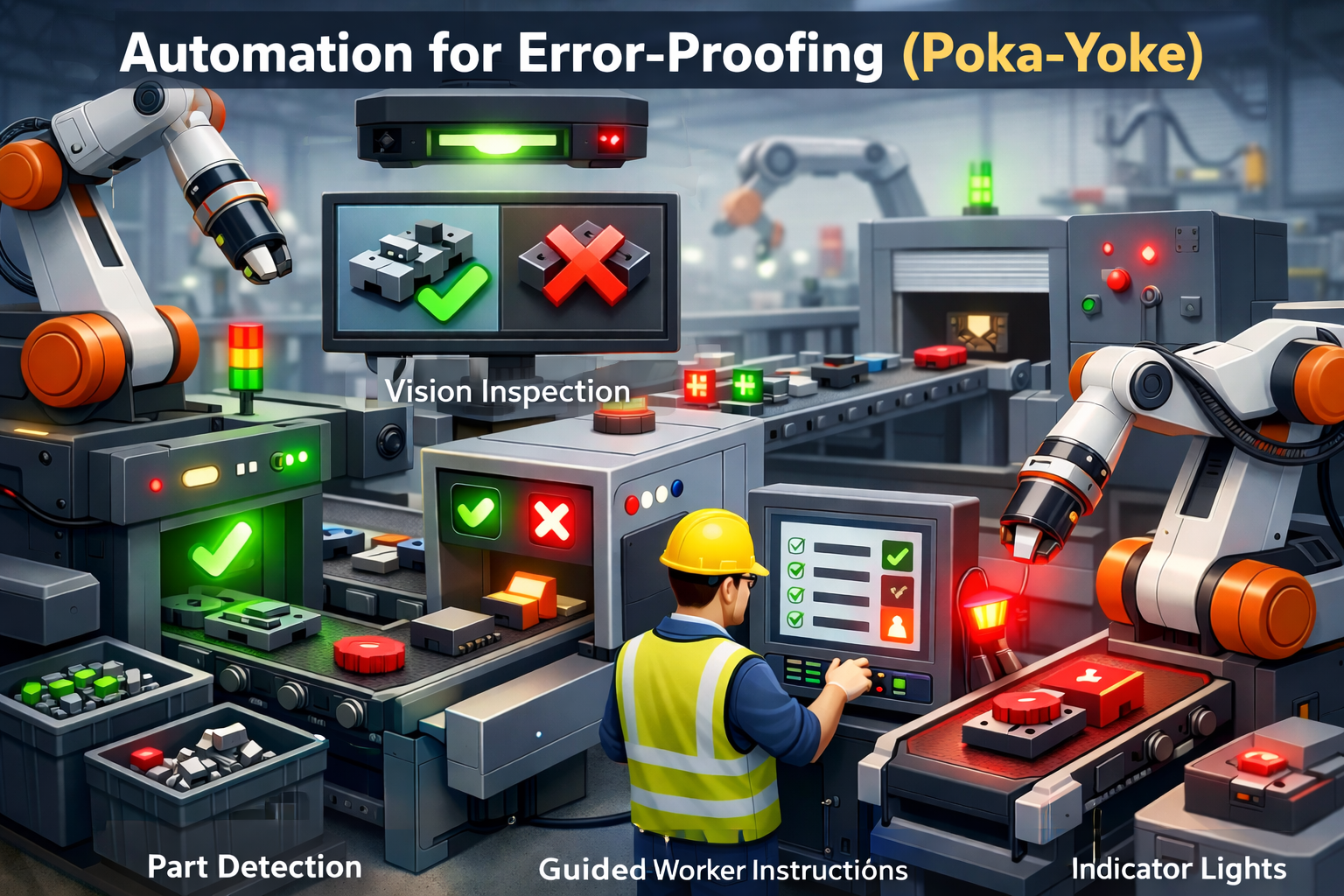
In today’s fast-paced industrial environment, even small errors can lead to major losses rework, delays, quality issues, and customer dissatisfaction. That’s why error-proofing (Poka-Yoke) has become a critical strategy for modern operations.
Automation plays a powerful role in eliminating human error by ensuring consistency, precision, and real-time control across processes. By integrating intelligent systems, businesses can build operations that are not only efficient but also nearly error-free.
Here are 6 impactful ways to use automation for error-proofing:
1.Automating Repetitive Tasks
Problem:
Manual repetitive tasks are highly prone to human error due to fatigue, distraction, or inconsistency.
Solution:
Automation replaces manual execution with machines or software that perform tasks with high precision every time. This ensures consistency and eliminates variability. Automation reduces the “human factor,” which is a major cause of defects in production processes.
At QeMatic, robotic process automation (RPA) is used to automate repetitive workflows like data entry, reporting, and order processing, ensuring zero manual errors and improved accuracy.
2.Real-Time Monitoring and Alerts
Problem:
Errors often go unnoticed until late stages, leading to costly rework or product rejection.
Solution:
Automation systems with sensors and IoT enable real-time monitoring, instantly detecting deviations and triggering alerts before issues escalate. This helps businesses identify inefficiencies and resolve them quickly.
QeMatic integrates smart monitoring systems that provide live dashboards and alerts, allowing teams to take corrective action immediately and prevent defects from spreading.
3.Standardization of Processes
Problem:
Lack of standardized processes leads to inconsistent outputs and frequent mistakes.
Solution:
Automation enforces predefined workflows and rules, ensuring every task follows the same standard process every time.
This improves consistency and quality across operations.
QeMatic uses Business Process Improvement (BPI) and data-driven design to standardize operations, ensuring error-proof workflows that are scalable and repeatable.
4.Automated Quality Inspection
Problem:
Manual inspection is slow, inconsistent, and prone to oversight.
Solution:
Automated inspection systems (vision systems, sensors, AI) can detect defects instantly with high accuracy.Automation ensures consistent quality checks and reduces defects significantly.
QeMatic deploys intelligent inspection and validation systems that continuously monitor product quality, ensuring only defect-free outputs move forward.
5.Error Prevention through Smart Controls (Poka-Yoke)
Problem:
Operators may perform incorrect steps, leading to process errors.
Solution:
Automation introduces fail-safes and smart controls that prevent incorrect actions- like sequence locks, validation checks, or auto-stop mechanisms. Poka-Yoke systems are designed to prevent errors before they occur.
QeMatic designs intelligent automation systems with built-in validation rules and control mechanisms, ensuring errors are prevented-not just detected.
6.Data-Driven Decision Making
Problem:
Poor decisions due to inaccurate or delayed data can lead to operational errors.
Solution:
Automation ensures accurate, real-time data collection and analytics, enabling better decision-making and process optimization. It also improves visibility and reduces manual data entry errors.
QeMatic leverages advanced analytics and Time & Motion studies to provide actionable insights, helping businesses continuously improve processes and eliminate recurring errors.
Conclusion
Error-proofing is no longer just a quality initiative- it’s a strategic necessity. Automation enables organizations to move from error detection to error prevention, ensuring higher productivity, better quality, and reduced operational costs.
With the right automation partner like QeMatic, businesses can build smarter, more resilient operations where errors are minimized and performance is maximized.
Rushika Shah | Journalist
Ahmedabad