
 By Navjivan Express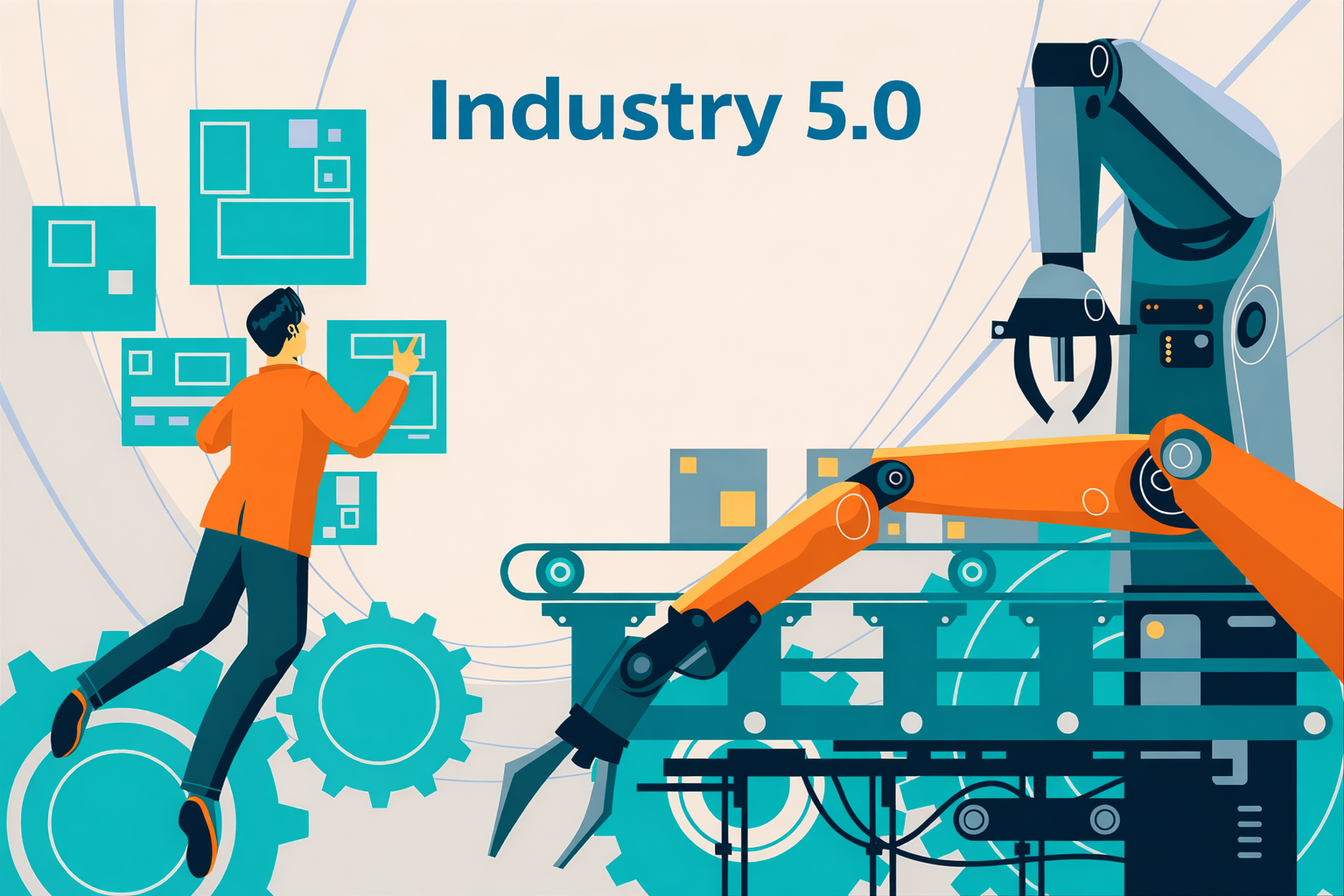
“A few years ago, if you walked into a factory, you would mostly see machines doing the heavy lifting and workers closely watching them. Everything was designed for speed, efficiency, and output. The more automated the system, the better it was considered.”
But over time, something started to change.
As factories became more advanced, they also became more complex. Machines were generating massive amounts of data. Production lines were moving faster than ever. Yet, despite all this technology, companies began to notice a gap. Systems could process data, but they couldn’t always make the right decisions in unexpected situations. They lacked human judgment, creativity, and experience.
This is where the idea of Industry 5.0 began to take shape.
Instead of asking, “How can machines replace humans?”, manufacturers started asking a different question:
“How can machines and humans work better together?”
Imagine a modern shopfloor today. A robot is handling repetitive assembly work with perfect precision. Right beside it, a human operator is monitoring the process, making adjustments, solving problems, and ensuring quality. The machine brings speed and consistency. The human brings understanding and decision-making.
This balance is what defines Industry 5.0.
It is not about removing people from the process. It is about bringing them back to the center. Machines take care of repetitive and physically demanding tasks, while humans focus on creativity, innovation, and critical thinking. And this shift is becoming important for a simple reason.
Manufacturing today is no longer just about producing more. It is about producing smarter. Factories deal with complex supply chains, changing customer demands, and constant pressure to improve efficiency. In such an environment, technology alone is not enough. Human expertise is still essential.
Industry 5.0 recognizes this reality. It builds systems where technology supports workers instead of replacing them. It creates a workplace where humans and machines complement each other, combining efficiency with intelligence.
In the end, the goal is simple not just smarter factories, but better collaboration between people and technology.
What the Shopfloor Looked Like Earlier
In traditional factories, most monitoring was manual.
- Operators checked machine gauges.
- Supervisors walked across the shopfloor to inspect equipment.
- Maintenance teams fixed machines only after breakdowns occurred.
This reactive approach worked for years, but it had challenges:
- Unexpected machine downtime
- Delayed maintenance
- Production inefficiencies
Today, with AI and smart sensors, the process is changing.
How AI Assists Workers on the Shopfloor
Modern factories now use AI-powered systems and connected machines to monitor operations in real time.
For example:
- Sensors track machine temperature and vibration.
- AI systems analyze the data continuously.
- The system alerts operators if something unusual happens.
But here is the key idea:
AI provides insights, but humans make the final decisions.
Example:
- AI predicts that a machine may fail in the next 24 hours.
- The maintenance engineer evaluates the situation.
- The team decides whether to stop the machine or continue production.
In this way, technology becomes a decision-support tool.
The Strengths of Humans vs AI
Industry 5.0 works because humans and machines have different strengths.
AI is good at:
- Processing large volumes of data
- Detecting patterns quickly
- Predicting maintenance issues
- Optimizing production schedules
Humans are good at:
- Understanding real-world situations
- Making complex decisions
- Solving unexpected problems
- Improving processes creatively
When these strengths combine, factories become more intelligent and more adaptable.
A Simple Example from Manufacturing
Imagine a factory producing automotive components.
Earlier:
- Quality inspectors manually checked finished parts.
- Defects were sometimes discovered after hundreds of parts were produced.
Now with AI-based vision systems:
- Cameras inspect each component instantly.
- AI detects even the smallest defect.
But the quality engineer still analyzes the issue and adjusts the production process.
So the collaboration looks like this:
- AI detects the problem quickly
- Humans understand the root cause and fix it
This combination saves time, cost, and materials.
Industry 5.0 and India
India’s manufacturing sector is undergoing a noticeable transformation in both production and distribution methods. Industries are gradually adopting advanced technologies and moving toward Industry 5.0 in their day-to-day operations.
However, the transition is not uniform. Many businesses are still at the stage of understanding Industry 4.0 and have not yet fully begun their digital transformation. At the same time, some forward-looking companies are already preparing for the next phase, recognizing Industry 5.0 as the future of manufacturing.
To support this shift, India has been investing in education and skill development to prepare its workforce. While these efforts were initially focused on Industry 4.0, Industry 5.0 requires a broader and more comprehensive approach. Along with technical skills, there is a growing need for capabilities such as cognitive computing, effective human-machine collaboration, and soft skills like communication and problem-solving.
These skills are essential because they help ensure smooth interaction between humans and automated systems, allowing organizations to fully benefit from advanced technologies.
Industry 5.0 represents a future where humans and machines work together rather than in isolation. By encouraging this collaboration, India aims to improve productivity, drive innovation, and build a more sustainable and efficient manufacturing sector.
Creating Human-Centric Factories
One major focus of Industry 5.0 is improving the working experience for employees. Instead of making workers adapt to machines, technology adapts to workers.
Examples include:
- Collaborative robots (cobots) helping workers lift heavy parts
- Digital dashboards simplifying production monitoring
- AI assistants guiding technicians during maintenance
The idea is not to remove workers from factories.
It is to empower them with smarter tools.
How QeMatic Aligns with Industry 5.0
QeMatic is a strong real-world example of Industry 5.0 in action. It combines AI, automation, and human expertise to create smarter and more efficient systems. Instead of replacing workers, it helps them work better by removing repetitive tasks and providing intelligent insights. This reflects the true idea of Industry 5.0- where humans and machines collaborate to build the future of manufacturing.
Conclusion
Industry 5.0 shows that the future of manufacturing will not be fully automated factories with no people.
Instead, it will be factories where:
- Humans and machines collaborate
- AI supports decision-making
- Workers focus on innovation and improvement
Technology will continue to evolve. But the most successful factories will always rely on something that machines cannot replicate human experience, judgment, and creativity. And that is exactly what Industry 5.0 is all about.
Rushika Shah | Journalist
Ahmedabad