
 By Navjivan Express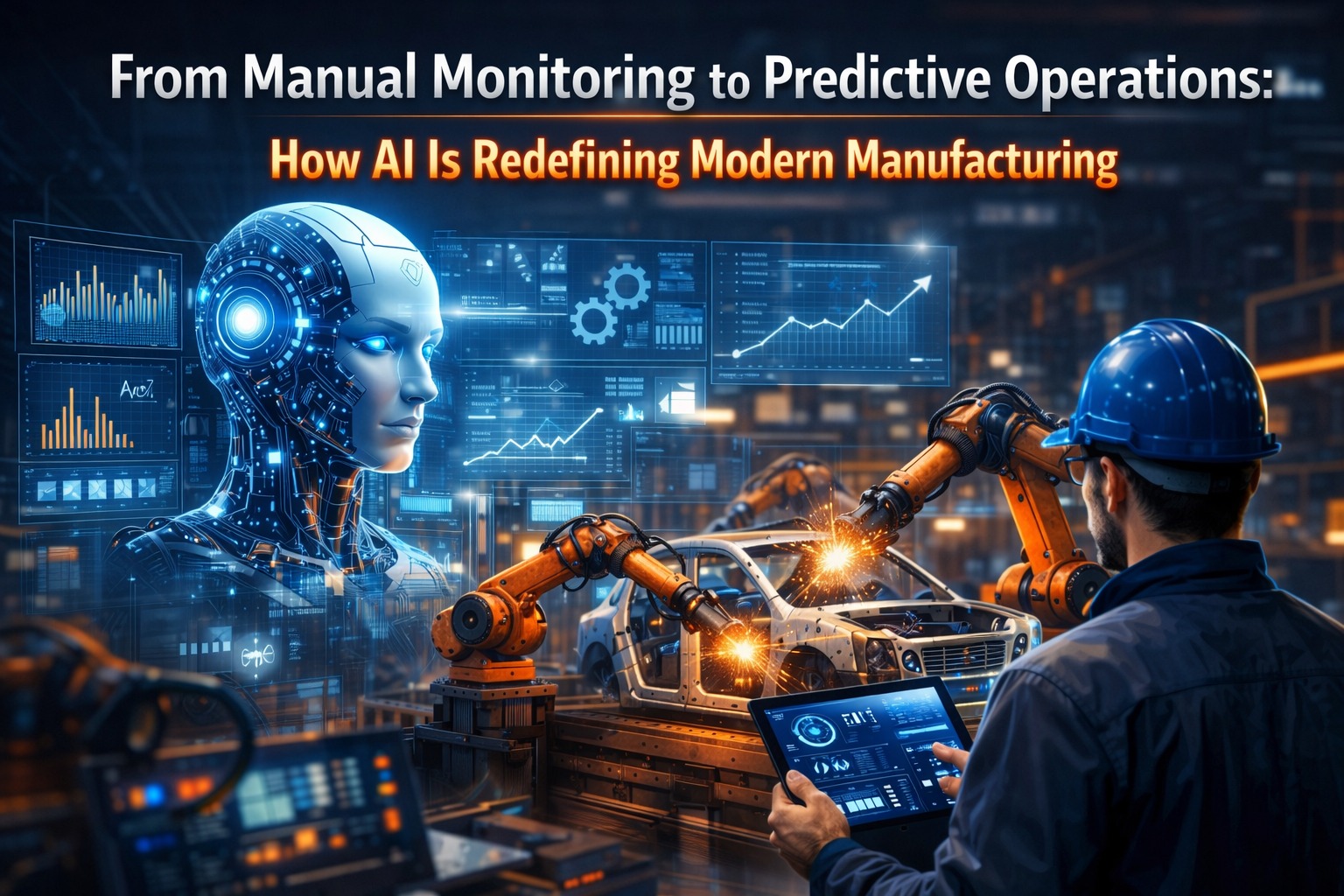
‘For many years, manufacturing plants have relied heavily on manual monitoring and routine inspections to keep operations running smoothly.’
Supervisors walk across the shop floor to check machine performance. Operators observe gauges and machine panels. Maintenance teams step in only after equipment begins to malfunction. This traditional approach has supported factories for decades. However, as production environments become more complex and competitive, its limitations are becoming increasingly clear.
Manual monitoring is reactive rather than proactive and consumes valuable time and labor. Most importantly, problems are often detected only after they have already disrupted production.
Today, manufacturing is moving toward a more intelligent approach – AI-driven predictive operations supported by digital manufacturing platforms. Instead of waiting for machines to fail, companies can anticipate issues before they escalate.
Platforms built for manufacturers, such as those developed by QeMFG, focus on a powerful principle:
Build. Plan. Deliver.
Through AI-assisted planninuiubg and engineering-grade software designed for India’s manufacturing ecosystem, companies can connect shop floor operations with intelligent decision-making tools.
The Reality of Traditional Shop Floor Monitoring
In many manufacturing facilities, daily monitoring still depends largely on human observation and scheduled inspections.
Typical practices include:
- Operators recording machine readings manually
• Maintenance teams inspecting equipment at fixed intervals
• Production managers responding to unexpected downtime
• Quality teams checking finished products for defects
While this approach provides basic oversight, it also creates several operational challenges:
- Equipment issues detected too late
• Maintenance performed only after failures
• Time spent collecting data instead of analyzing it
• Limited real-time visibility into production performance
As manufacturing becomes more data-driven, relying solely on manual monitoring is no longer sufficient. AI-enabled manufacturing systems help bridge this gap by turning operational data into actionable insights.
How Artificial Intelligence Improves Operational Visibility
Artificial Intelligence offers a new way of understanding factory operations.
Instead of relying only on human observation, AI systems analyze large volumes of operational data in real time to detect patterns and anomalies earlier.
These systems process information such as:
- Machine sensor readings
• Temperature and vibration signals
• Production throughput data
• Historical equipment performance records
Through continuous analysis, AI can identify small deviations that humans might overlook.
For example, a slight increase in machine vibration may seem insignificant to an operator. However, when AI compares this signal with historical failure data, it may detect early signs of mechanical wear.
Maintenance can then be scheduled before the issue disrupts production.
The benefits are clear:
- Fewer unexpected shutdowns
• More predictable maintenance planning
• Improved production stability
Solutions like QeMFG’s AI-assisted planning tools help manufacturers integrate this intelligence directly into daily operations.
Predictive Maintenance: The First Step Toward Smart Manufacturing
Predictive maintenance is often the first AI capability manufacturers adopt.
Traditional maintenance strategies typically follow two approaches:
Reactive maintenance – repairing equipment after it fails
Preventive maintenance – servicing machines at fixed intervals
Both approaches have drawbacks. Reactive maintenance leads to unexpected downtime, while preventive maintenance may replace components that still have useful life remaining.
Predictive maintenance provides a smarter alternative.
By analyzing sensor data and historical patterns, AI systems can forecast potential failures before they occur.
Manufacturers implementing predictive maintenance often experience:
- Reduced unplanned downtime
• Lower maintenance costs
• Longer equipment lifespan
• Improved production planning
Digital manufacturing platforms such as QeMFG Smart PPS (Production Planning & Scheduling) support this process by stabilizing production plans and coordinating maintenance with shop floor schedules.
AI Applications Beyond Maintenance
Although predictive maintenance is often the starting point, AI can improve several other manufacturing operations.
Production Optimization
AI systems can analyze production data to identify bottlenecks and inefficiencies.
If a workstation slows overall throughput, AI tools quickly highlight the issue. Production managers can then rebalance workloads or adjust scheduling.
Tools like QeMFG Smart PPS help manufacturers stabilize production plans, run the shop floor effectively, and provide accurate delivery commitments.
Predictive Quality Management
Traditional quality checks often occur after production.
AI enables manufacturers to detect conditions that may lead to defects before they occur, such as:
- Temperature fluctuations
• Tool wear
• Material inconsistencies
By identifying these factors early, manufacturers can significantly reduce:
- Scrap
• Rework
• Quality defects
Energy Optimization
Energy is a major cost in manufacturing operations.
AI-driven monitoring systems can analyze machine usage patterns and identify opportunities to reduce energy waste by:
- Optimizing machine schedules
• Detecting inefficient production cycles
• Reducing idle energy consumption
Many factories achieve significant energy savings after implementing AI-driven monitoring systems.
The Role of Digital Manufacturing Platforms
The transition toward predictive operations is supported by digital manufacturing platforms that integrate shop floor data, analytics, and enterprise systems. Companies such as QeMFG help manufacturers modernize operations through ERP systems, AI-enabled analytics, and connected factory technologies.
Their approach centers around Build. Plan. Deliver.
- Build – Engineering-grade digital tools for manufacturers
• Plan – Intelligent production planning through Smart PPS
• Deliver – Customer-focused workflows supported by QeMFG SmartCRM
These platforms connect machines, processes, and business operations into a single digital ecosystem. Instead of managing disconnected spreadsheets and systems, manufacturers gain real-time visibility across the entire production process.
Customer communication also improves through QeMFG Smart CRM, which helps teams track customer requests, follow-ups, and service closures efficiently.
Typical Work Processes in Digital Manufacturing Systems
Modern digital manufacturing platforms support several key workflows.
Data Collection and Integration
Machine data such as cycle times, downtime events, and equipment performance is automatically captured through sensors and integrated systems.
Real-Time Monitoring
Dashboards provide live visibility into machine performance and production progress without requiring physical inspections.
Predictive Analytics
AI models analyze historical and real-time data to detect patterns, predict failures, and highlight inefficiencies.
Decision Support and Optimization
Managers can make better decisions regarding maintenance scheduling, production planning, and resource allocation.
When manufacturers require custom software or system integrations, QeMFG also provides specialized IT services designed for real manufacturing challenges, delivering reliable engineering and robust integrations.
What Predictive Operations Look Like in Practice
In a digitally enabled factory, a production manager no longer needs to manually inspect every machine.
Instead, a centralized dashboard displays equipment conditions across the facility:
- Green indicators show normal operation
• Yellow alerts highlight components needing attention
• Red warnings indicate urgent issues
Maintenance tasks can be scheduled before failures occur, helping factories operate more smoothly and predictably.
The Future: Intelligent and Connected Manufacturing
Artificial Intelligence is not replacing human expertise in manufacturing.
Engineers, operators, and managers remain essential for decision-making and process improvement.
What AI provides is greater visibility, predictive insight, and faster decision support.
With continuous analysis of operational data, factories can:
- Detect issues earlier
• Prevent equipment failures
• Improve production efficiency
• Optimize overall performance
As Andrew Ng famously stated:
“AI is the new electricity.”
Within manufacturing, that “electricity” is powering the shift from manual monitoring to predictive, data-driven operations.
Conclusion
Every manufacturing facility generates enormous volumes of operational data each day. For many years, much of this information remained unused.
Today, with the integration of AI, IoT, and digital manufacturing platforms like those offered by QeMFG, manufacturers can transform raw data into powerful operational insights.
Through solutions such as Smart PPS for production planning, SmartCRM for managing customer interactions, and specialized IT services for custom manufacturing software, companies can connect every stage of their operations.
By predicting problems, optimizing workflows, and improving decision-making, manufacturers can move beyond observation and begin building smarter, more resilient production systems for the future.
Rushika Shah | Journalist
Ahmedabad