
 By Navjivan Express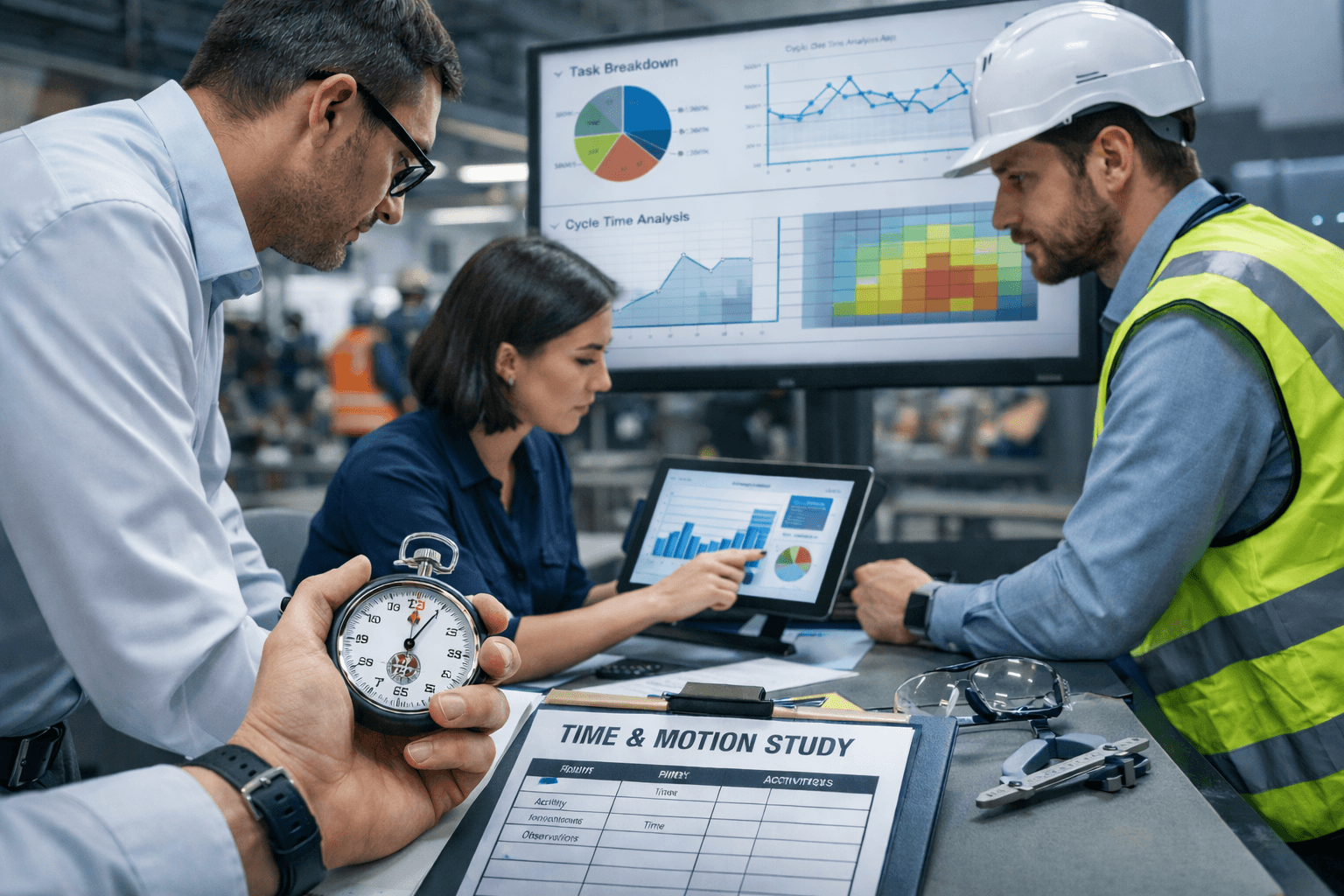
In today’s highly competitive industrial world, manufacturing companies are constantly trying to do more work with fewer resources. They must maintain high quality, faster production, and strict delivery deadlines at the same time.
Because of this pressure, many industries are now revisiting an old but powerful management method called Time and Motion Study.
Although this technique was first developed more than 100 years ago, it is becoming relevant again. The difference today is that companies are using digital tools, analytics, and workflow software to perform these studies more accurately.
Simply put, Time and Motion Study is about understanding how work actually happens on the factory floor and finding ways to make it faster and more efficient.
As management expert Peter Drucker once said,
“Efficiency is doing things right; effectiveness is doing the right things.”
Time and motion studies help companies achieve both.
Why Manufacturing Companies Are Using Time and Motion Studies Again?
Manufacturers today face several challenges:
- Global competition
- Rising labour and energy costs
- Supply chain disruptions
- Increasing demand for faster delivery
Even small inefficiencies in production can cost companies millions over time.
Many production managers initially believe productivity problems are caused mainly by machine breakdowns or equipment failures.
But when companies analyse their operations closely, they often discover that the real issues come from how work is organised.
For example, common problems include:-
- Production lines that are not balanced
- Workers waiting for machines to finish tasks
- Machines staying idle between operations
- Materials travelling long distances inside the factory
- Repeated handling of the same parts
- Delays between production stages
Individually these problems may look small.
But across multiple machines, shifts, and production lines, they can significantly reduce overall productivity.
Time and motion studies help companies identify these hidden problems.
Finding Bottlenecks in Production Lines-
One of the most important outcomes of a time and motion study is identifying bottlenecks.
A bottleneck is simply a stage in the production process that slows everything down.
Imagine a production line where:-
- Cutting takes 1 minute
- Assembly takes 3 minutes
- Packaging takes 1 minute
Even if other steps are fast, the assembly stage becomes the bottleneck because it takes longer.
Time and motion studies help manufacturers find answers to questions like:-
- Which step is slowing down the process?
- Which machines are underused?
- How much time does each activity really take?
- Can some tasks be simplified or combined?
Once companies identify these issues, they can often increase production without buying new machines.
Improving Factory Layout and Material Movement
Another common problem in factories is poor layout design.
Over time, machines and workstations are often placed wherever space is available.
But this can create inefficient workflows.
For example:
A part may move from:
- Machine A → across the hall → Machine B → back again → Machine C.
This unnecessary movement wastes time, labour, and energy.
Time and motion studies analyse how materials move through the factory and suggest improvements such as:
- Rearranging machines for smoother production flow
- Reducing travel distance between processes
- Placing tools closer to workers
- Organizing workstations to reduce unnecessary movement
Even small layout changes can save several minutes per product, which becomes a huge saving at large production volumes.
How Digital Technology Is Improving Time and Motion Studies?
Traditionally, time and motion studies involved manual observation and stopwatches.
Today, technology has made the process much easier and more accurate.
Modern companies use digital workflow analysis platforms to study operations.
For example, platforms like Qematic allow manufacturers to:-
- Map production processes digitally
- Track process cycle times
- Identify bottlenecks
- Analyse equipment utilization
- Monitor operational performance continuously
Instead of guessing where inefficiencies exist, companies can now rely on data-driven insights.
This helps managers make better and faster decisions.
Supporting Continuous Improvement
Many manufacturing companies follow improvement strategies such as:-
- Lean Manufacturing
- Operational Excellence
- Six Sigma
These approaches focus on reducing waste and improving efficiency.
Time and motion studies support these initiatives by providing real operational data.
Instead of relying on assumptions, managers can ask:-
- Where is time being wasted?
- Which tasks take longer than expected?
- What steps can be eliminated?
This approach encourages continuous improvement.
Time and Motion Studies in the Industry 4.0 Era
Manufacturing is now moving toward Industry 4.0, where factories use:-
- Data analytics
- Automation
- Digital monitoring systems
- Smart manufacturing technologies
In this environment, time and motion studies are evolving.
They are no longer just about measuring time.
They are about understanding the entire workflow of a production system.
Modern analysis combines:-
- Industrial engineering principles
- Data analytics
- Workflow intelligence platforms
This allows companies to discover productivity improvements without always investing in new machines.
Sometimes the biggest gains come from better process design.
Conclusion
Time and motion studies are making a strong comeback in modern manufacturing.
With the help of digital tools and workflow analytics, companies can now analyse their operations more accurately than ever before.
By studying how work is actually performed, manufacturers can:-
- Identify inefficiencies
- Reduce production delays
- Improve factory layouts
- Increase equipment utilization
- Boost overall productivity
As industries continue to pursue operational excellence, QeMatic and modern workflow analysis platforms will play an increasingly important role.
In the end, improving productivity is not always about working harder or buying new machines.
Sometimes, it simply requires working smarter and understanding how work really happens.
Rushika Shah | Journalist
Ahmedabad